Overview
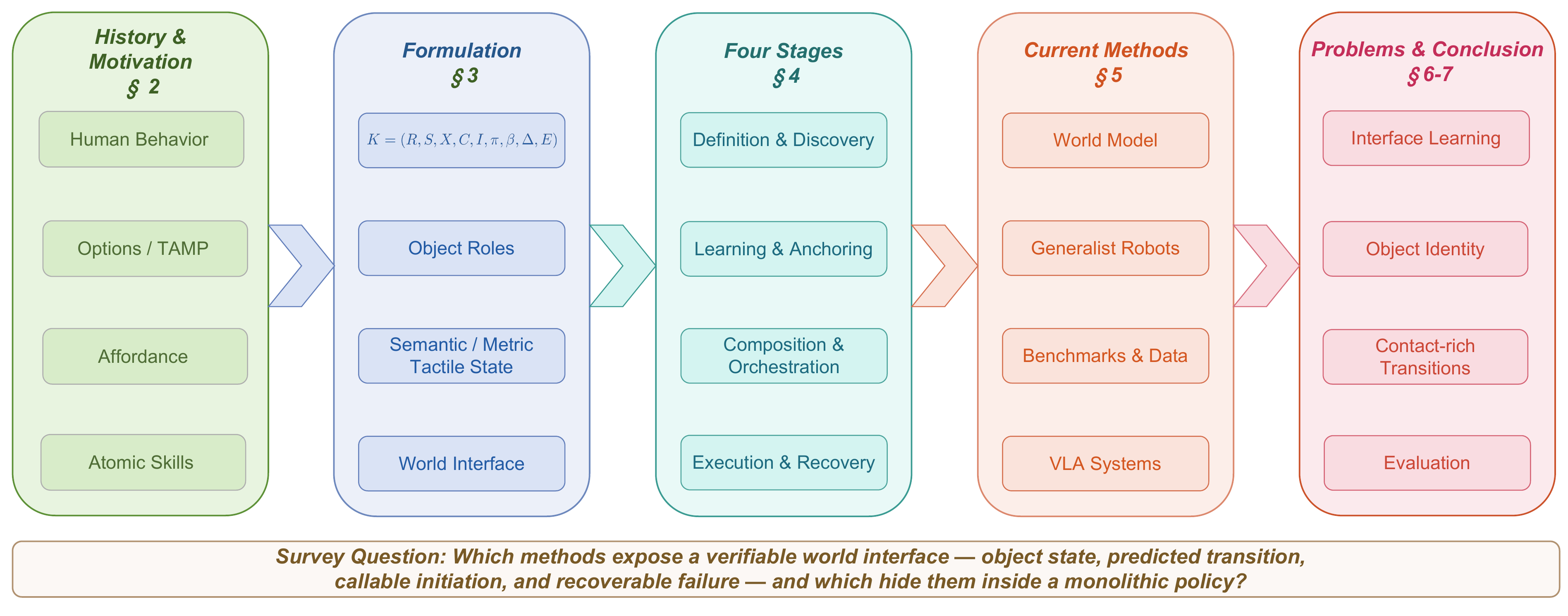
PraxisWorld treats manipulation as a world state → action interface → state transition problem. Instead of reading verbs such as pick, place, and insert as complete skill definitions, it asks which objects, contact modes, tolerances, initiation conditions, effects, and recovery checks make a physical transition executable.
Motivation
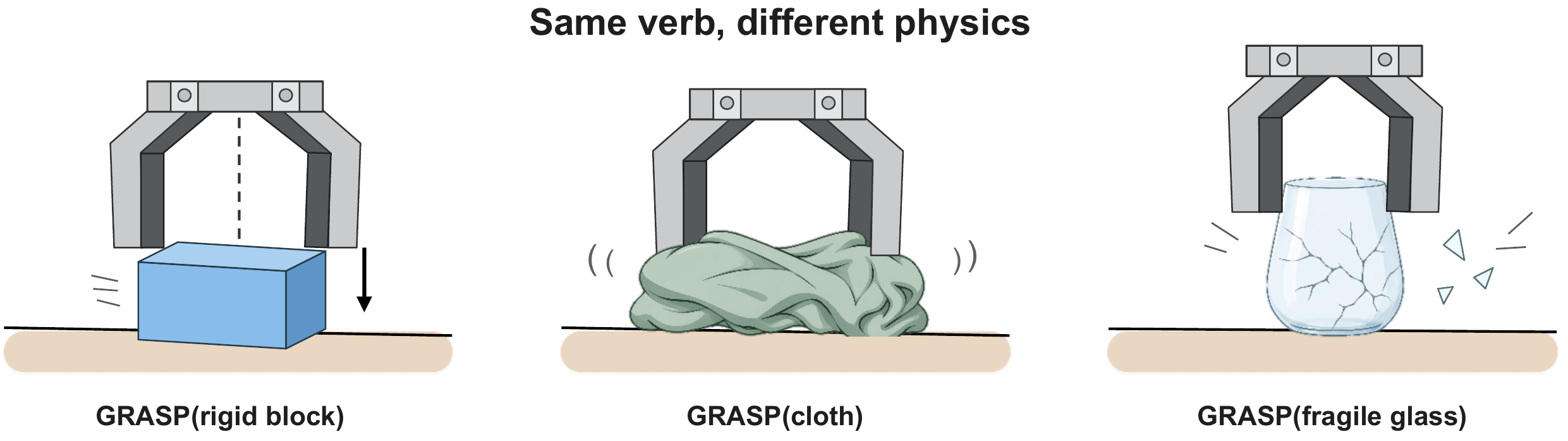
Framework
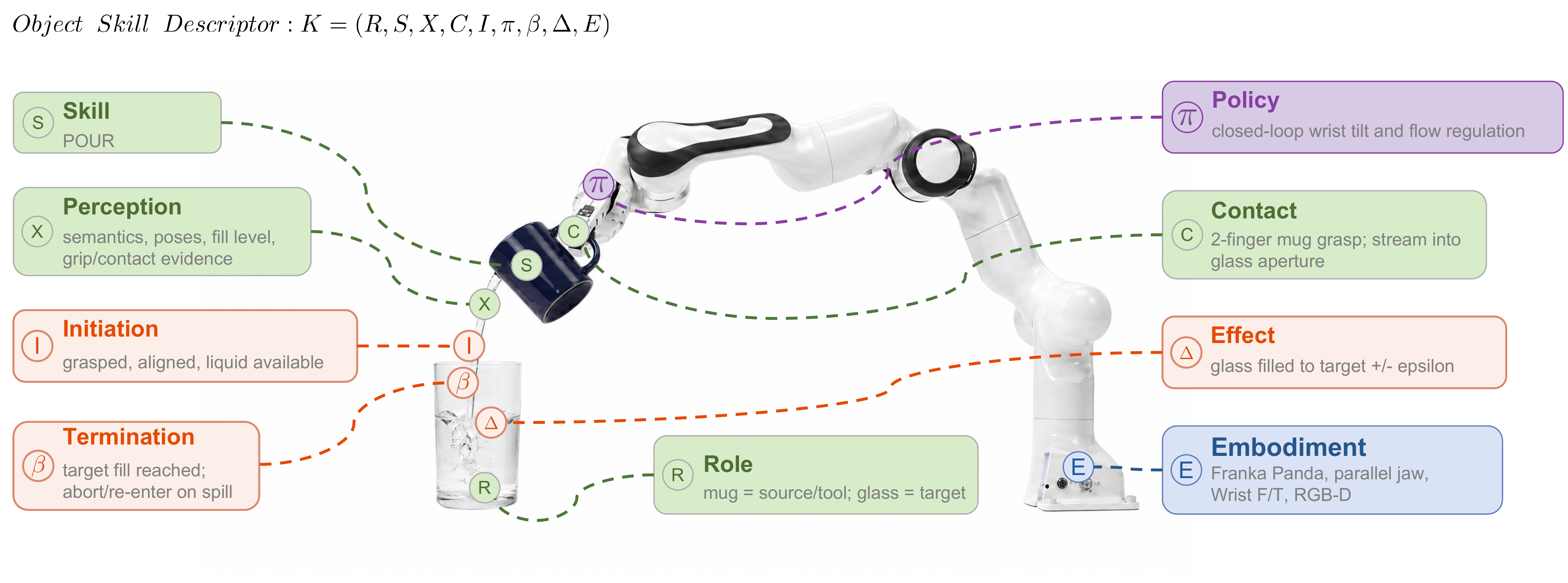
The survey formalizes an atomic skill as K = (R, S, X, C, I, π, β, Δ, E), connecting object anchors, world state, embodiment, contact constraints, initiation, policy, termination, predicted effect, and verification signals.

Lifecycle
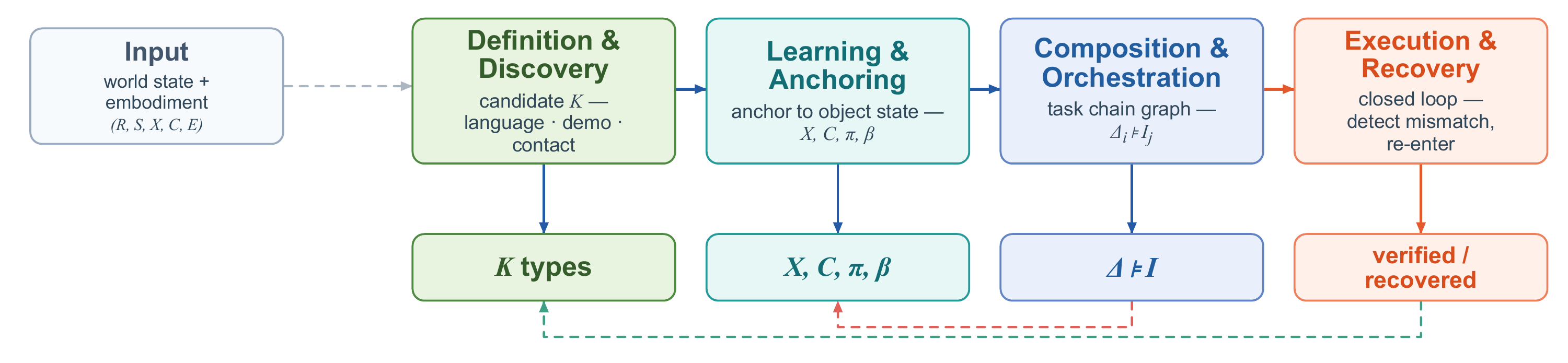
The skill descriptor becomes operational only when tied to the lifecycle of a manipulation system. PraxisWorld organizes that lifecycle into four stages — definition and discovery, learning and anchoring, composition and orchestration, and execution and recovery — treated not as separate topics but as a single pass through the same world-action model, from world state to a verified transition.

Current Methods
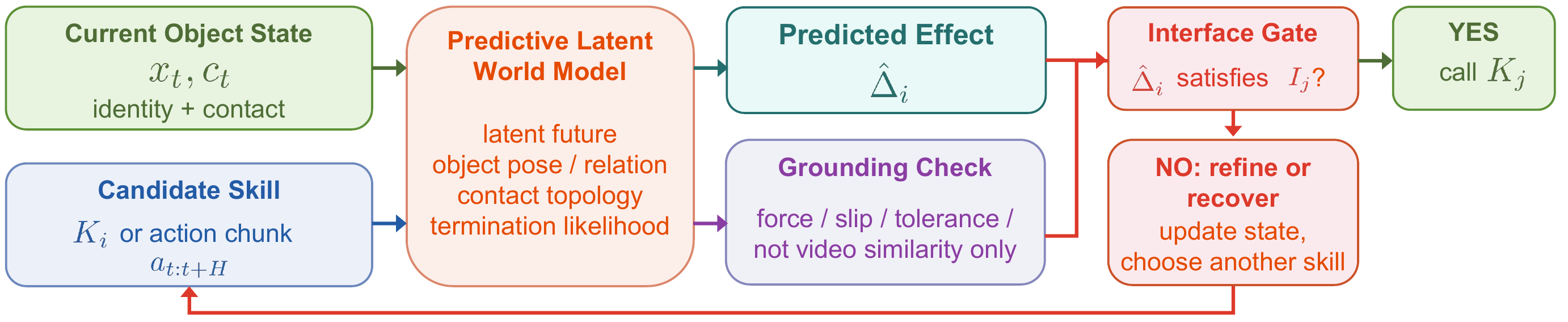
PraxisWorld rereads current systems by asking what part of the world-action loop they expose: observed object state, transition prediction, callable interface, verification, or recovery. JEPA-style and action-conditioned world models are analyzed as transition-interface estimators.
Meta-World Probe
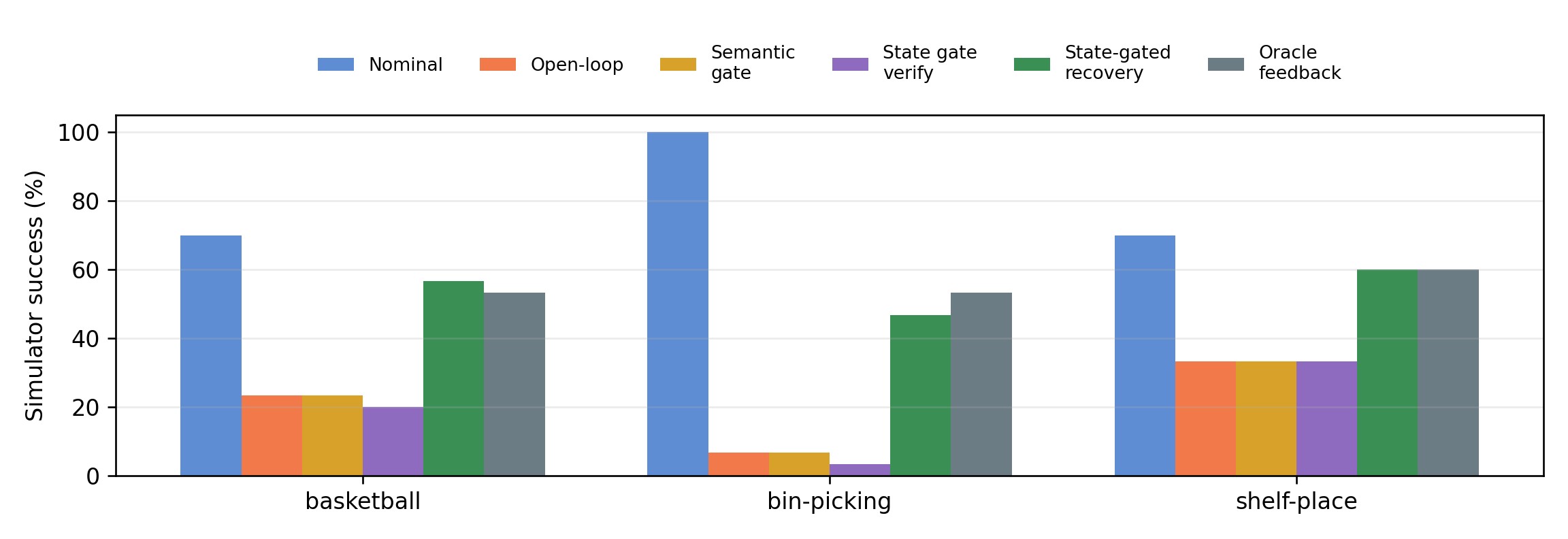
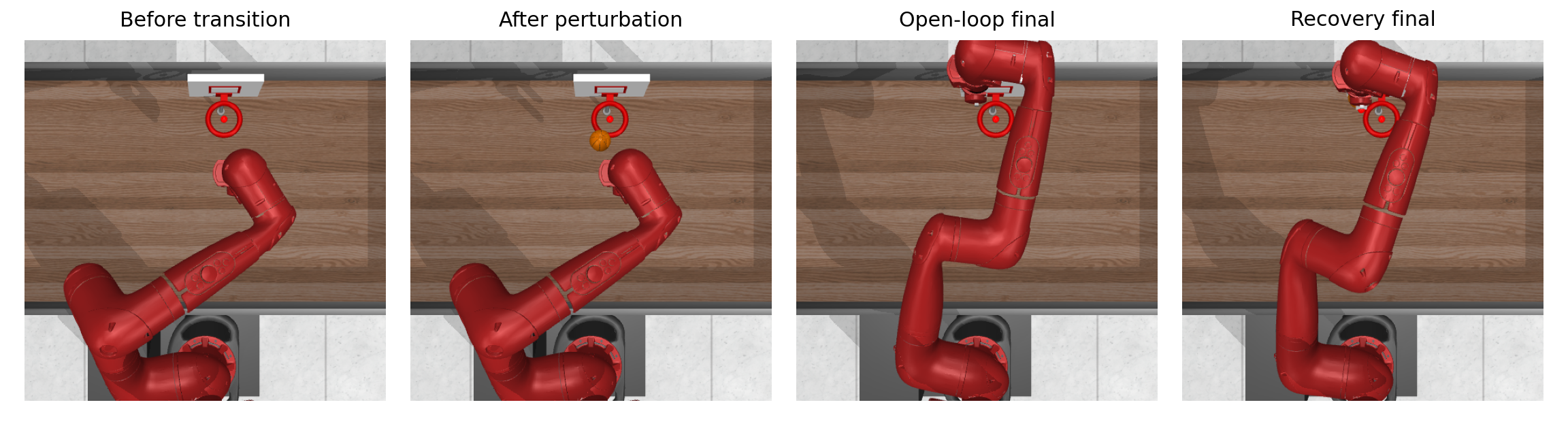
The manuscript includes a compact Meta-World V3 diagnostic over basketball, bin-picking, and shelf-place. The probe checks whether an explicit object-state gate can detect perturbed skill-boundary transitions and support recovery.
Simulation Demos
We instantiate PraxisWorld's execution-and-recovery loop on an industrial dual-arm mobile manipulator with dexterous hands in NVIDIA Isaac Sim. The flagship warehouse demo makes the framework's core claims visible: an object-state anomaly is observed (a tipped carton arriving from upstream), the task is checkpointed, a recovery skill re-enters from the observed state, the effect is verified, and execution resumes — followed by an effect-to-initiation re-plan (Δ ⊨ I) when a fragile blocker occupies the next placement slot, and material-conditioned grasps (cardboard clamp vs. glassware cradle).
Reference Map
Explore the survey's 191 cited works as an interactive, section-organized knowledge base — switch between a force-directed graph and a collapsible tree, search by title or author, filter by section, and open any reference for its details and BibTeX.
Citation
@misc{huang2026praxisworld,
  title={PraxisWorld: Object-Centric World-Action Model for Composable Robot Manipulation},
  author={Huang, Yu-song and Li, Yu-yan and Lu, Hong-liang and Wang, Hao-tian and Qiu, Xiao-yun and Xu, Wen-peng and Sheng, Yang-gang and Kuang, Zhao-nian and Chen, Yi-jie and He, Jin-tao and Liu, Dong-ling and Zheng, Xin-hu},
  year={2026},
  note={Survey manuscript}
}